
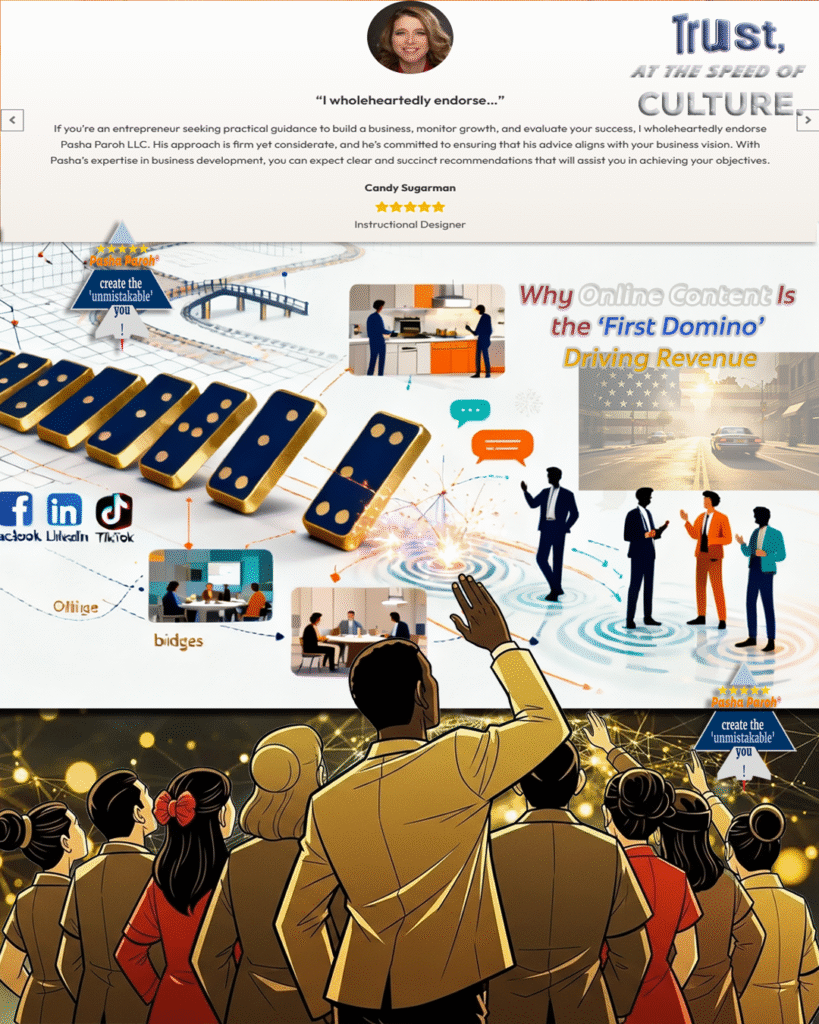
Word of Mouth in 2026: Why Online Content Is the ‘First Domino’ Driving Revenue
✨ In 2026, the businesses winning the trust game aren’t the ones posting the most online — they’re the ones whose content sparks the offline conversations that actually drive revenue.
📖 On page 11 of Jonah Berger’s New York Times BestSeller, he quotes: “Research by the Keller Fay Group finds that only 7 percent of word of mouth happens online.”
People will be surprised, think about their own lives, and some might change how they see online versus in-person conversations. Others might just shrug it off. After hearing this, many would start to think about how they talk to friends and family; maybe realizing that they usually recommend things in person, not online.
🤔 Some folks might start to question why we hear so much about advertising and sharing things online, if most of the talking actually happens face-to-face.
💼 I’ve spoken to tons of business owners who claim they rely on word of mouth, mostly. It is worth noting that many of those same business owners also say their business isn’t where they want it to be. They want more customers, greater ACV, and sustainability… just like you and me. Knowing that the human brain justifies what it wants to believe, the online difference between those business owners and the rest is that they have programmed themselves with the justification to not invest in marketing and maybe branding.
👥 People engage in a vast amount of offline activity, making in-person conversations a more frequent source of word-of-mouth, but where does the information come from?
📌 Most word-of-mouth volume still happens offline and is the most trusted influence; but the topics, frames, and ranking of what’s socially valuable or acceptable are increasingly seeded and shaped online — social media, news sites, and influencers set the agenda that people then discuss in person. (UpRiseCampaigns.org)
🌟 This is what makes Pasha Paroh so valuable to our Vision-Led Operators.
When you work with Pasha Paroh, you’re not just getting social media posts — you’re getting conversation architecture. Offline word-of-mouth is still the most trusted driver of decisions, but the spark that fuels those conversations now starts online. I design Facebook content that doesn’t just earn likes; it sets the agenda. My clients gain the ability to seed the very topics, frames, and values that people carry into living rooms, boardrooms, and backyards — turning online visibility into offline credibility, trust, and measurable action.
✨ Vision-led founders aren’t just looking for marketing; they’re looking for strategic elegance that signals intelligence. They’re tired of tinkering and DIY fatigue. Through neuroaesthetic content design, I help them step into recognition, alignment, and the authority to scale without dilution.
📊 Multiple large studies find the majority of day-to-day brand and news conversations occur face-to-face or by phone. For example, longitudinal WOM research (Keller Fay / related analyses) shows roughly ~75–90% of consumer conversations about brands happen offline (face-to-face or by phone). Nielsen’s Global Trust work likewise finds that recommendations from people you know are the single most trusted information source (≈80–83% trust).
📢 What’s missing from Jonah Berger’s quote, on page 11, is simply that “Online channels are the primary source of news, frames and many conversation starters.” Across multiple countries and large samples, a growing share of people say they get news and topical information from digital platforms and social media (Pew, Reuters Institute, Ofcom, etc.). For example, Pew finds that a majority of U.S. adults now get news at least sometimes from social media platforms; other national reports show internet/social channels edging out TV as the dominant place where many consumers first encounter an issue. (Pew Research Center)
🌐 What that means: people are increasingly “seeded” with content online (news articles, short videos, influencer posts) that becomes the raw material for later offline conversations, making online content the new “first domino.”
🚀 Moving into 2026:
• 📱 A Facebook post, Reel, or short article isn’t just marketing collateral; it’s the conversation starter.
• 🧠 When you publish strategically, you’re not buying attention for a moment — you’re manufacturing word-of-mouth ammunition that ripples into kitchens, Zoom calls, and sales meetings.
• 🌊 That ripple is what multiplies the ROI of content management.
• 🤝 People may not trust an ad directly, but if they saw it online first and then heard it echoed by a friend offline, the trust bridge is built.
• 🎯 Strategic online content ensures your talking points are the ones friends, colleagues, and neighbors repeat — so you gain credibility without being in the room.
• 📈 As algorithms tighten, ad costs climb, and consumer skepticism spikes, businesses can’t just “rent” reach — they need owned, agenda-setting content that earns both shares and spoken conversations, which is what Pasha Paroh specializes in.
• 💡 Word-of-mouth has always been the growth multiplier, but in 2026, whoever seeds the conversation online wins the offline trust economy.
💎 And when that ripple hits clients, collaborators, and communities, something bigger happens: their audiences feel safe, seen, and elevated. Teams rally around a coherent vision, and next-generation leaders inherit a playbook of substance over trend-chasing.
💬 Hiring an elite content manager in 2026 is no longer about posting pretty graphics. It’s about engineering the raw material for the most trusted marketing channel in existence: face-to-face conversations. The right online content ensures your brand is the topic, your framing is the lens, and your values are the filter people carry with them into every offline conversation that drives revenue.
🧩 What I deliver is not just content management — it’s cultural infrastructure. Every piece of content is designed to seed conversations that upgrade standards in consulting, wellness, tech, culture, and finance. My work ensures my clients don’t blend into the noise; they become the anti-generic signal markets respect.
📺 For many years, experts have studied how TV, newspapers, and now the internet affect what people care about and talk about. They found that when the news or social media talks a lot about something, people start to think that topic is important — even if they didn’t before.
This idea was first proven a long time ago, and it’s still true today, even with the internet and social media. Basically, whatever stories or issues the media focuses on, those are the things the public usually pays attention to and wants to discuss.
⚡ Nowadays, social media like Facebook, X (Twitter), and TikTok also help decide what everyone is talking about. Sometimes, they even do it faster and in a way that feels more personal to each person.
📌 In short:
The more the media talks about something, the more we think it matters… and social media is now a big part of that process.
Ready to turn your online content into offline authority? Schedule a consultation with Pasha Paroh today. 🚀📅🤝➡️ www.Calendly.com/PashaParoh
-Pasha Paroh | Now with Google Ai Overview
PASHA PAROH LLC
Neuro-Aesthetic Innovator
Text: 302.932.6256 | PashaParoh@gmail.com
www.PashaParoh.online
#OnlineContentMarketing #WordOfMouthStrategy #OfflineTrust #ConversationArchitecture #MarketingForCEOs #NeuroAestheticStrategy #RevenueGrowth #VisionLedLeadership #SocialMediaInfluence #ContentThatConverts #PashaParoh
Leave a Reply